

Catch documentation risk before a payer does.
Claimo reads your session notes, treatment plans, claims, and authorizations together, then shows you the gaps a payer would flag, with the evidence to fix them.
Pre-launch · Onboarding select ABA practices
Grounded in the public record
Built with practicing ABA operators.
Overpaid when ABA claims missed MassHealth's 10:1 supervision ratio
Massachusetts Inspector GeneralOne review across the records payers actually scrutinize.
Medicaid and commercial reviewers keep raising the bar for what counts as a defensible note, plan, and reauth. Claimo connects those records so your team can fix issues while they are still cheap to fix.
Catch documentation gaps before an audit does.
Session notes and treatment plans are checked for the missing signatures, thin narratives, and unsupported goals that payer reviewers flag first.
Every document checked against every other.
Every claim is matched to its note, its authorization, and the plan behind it. Mismatches surface during billing review, while you can still do something about them.
BCBA-calibrated clinical review.
Note QA is tuned against a labeled golden set of real, BCBA-reviewed ABA documentation, not generic AI guesses.
No per-usage pricing. No lock-in.
Simple plans for practices of every size. No per-claim fees, and no meter running while your team reviews its own documents.
The product
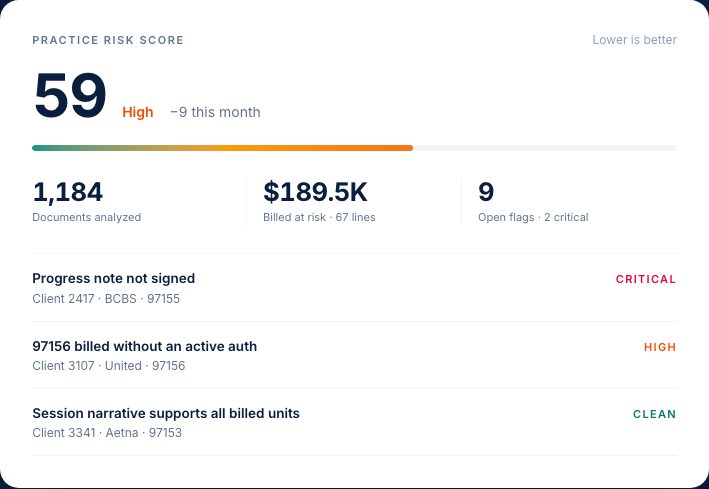
Your whole practice's payer risk, on one screen.
The Practice Risk Score rolls every open finding into a single 0 to 100 index and breaks billed dollars at risk down by driver. Leadership sees where exposure sits and which fixes move the number.
Interface shown with illustrative demo data, not customer records.
Capabilities
What Claimo reviews across your practice.
One review connects your notes, plans, claims, and authorizations, then rolls what it finds into a picture of the whole practice.
Document intake
Upload session notes, treatment plans, CMS-1500 claims, and authorizations. They are the same files your clinic already produces. Claimo reads them, links related records for each client, and starts the review on its own, with PHI stripped before any external AI sees a word.
Learn moreFindings with evidence
Every flag points to the exact language and claim lines that triggered it, with severity, the payer-facing reason, and a plain-language fix. These are risk signals your team can act on, not verdicts.
Learn moreCompliance Risk Index
Every open finding rolls into a single 0 to 100 score, with billed dollars at risk grouped by root cause. Leadership sees where the exposure sits and what to fix first.
Learn moreAuthorization intelligence
Utilization, expirations, and reauthorization readiness tracked for every client, so an expiring or over-limit authorization never turns into unbillable sessions.
Learn moreProvider breakdowns
Per-provider views show whose documentation drives risk and where credentials do not match billed codes. Coaching opportunities, surfaced before they show up in an audit letter.
Learn moreBuilt against BCBA-reviewed ABA documentation. Real notes, real plans, real claims.
Trust and security
Built for high-compliance healthcare from day one.
Claimo handles some of the most sensitive records a practice has, so protection is designed into how documents are stored, stripped, analyzed, and reviewed.
HIPAA-aligned safeguards
Technical and organizational safeguards designed around HIPAA requirements from day one.
BAA-covered onboarding
A Business Associate Agreement is part of onboarding before PHI ever flows into Claimo.
PHI stripped before AI
Documents are de-identified before any external AI review of their text.
Encryption everywhere
AES-256-GCM field-level encryption at rest and TLS for every connection in transit.
MFA and tenant isolation
Multi-factor authentication with row-level isolation scoping every query to your organization.
Append-only audit logs
Every access to protected records is written to an audit trail that cannot be edited.

Our mission
Less time fighting preventable paperwork. More time focused on care.
Ethical practices are absorbing payer scrutiny they did nothing to cause. Claimo reviews the paperwork you already produce the way a payer will, before it leaves the building.